
Puppy Sleep Schedule by Age and Breed: The Complete 2026 Guide
Raising a puppy is exciting, but it also comes with a lot of questions—especially about sleep. Puppies need plenty of rest to grow healthy and strong, but the right amount can vary based on their age and breed. Understanding your puppy’s sleep needs will help you create a routine that keeps them happy and well-rested.
Bringing home a puppy means a lot of firsts — first walk, first bath, first chewed-up shoe. But one of the most overlooked “firsts” is figuring out how much sleep your new puppy actually needs. Unlike adult dogs, puppies aren’t just sleeping to rest — they’re sleeping to grow. Bones lengthen, muscles develop, and the brain files away everything learned that day, almost entirely while your puppy is asleep.
If you’ve searched for a puppy sleep schedule by age and breed, you’ve probably noticed the numbers vary wildly from one source to the next. That’s because sleep needs shift constantly during the first year, and breed size changes the equation even further. Here’s a clear, practical breakdown you can actually use.
Why Puppy Sleep Is So Important
Why Puppies Need So Much More Sleep Than Adult Dogs
A puppy’s brain and body are under constant construction. During deep sleep, growth hormone release peaks, muscle tissue repairs itself, and short-term memories from training sessions get converted into long-term learning. Skip enough sleep, and you’ll usually see it show up as behavior problems, not just tiredness — puppies who are overtired tend to get more wound up, not less, showing signs like nipping, zoomies, and an inability to settle even when they’re clearly exhausted.
This is the part most new owners get backwards: a cranky, hyper puppy at 8 PM usually needs a nap, not more playtime.
Sleep is when a puppy’s body grows, muscles repair, and the brain processes everything they’ve learned during the day. Without enough rest, puppies can become cranky, hyperactive, or even more prone to illness.
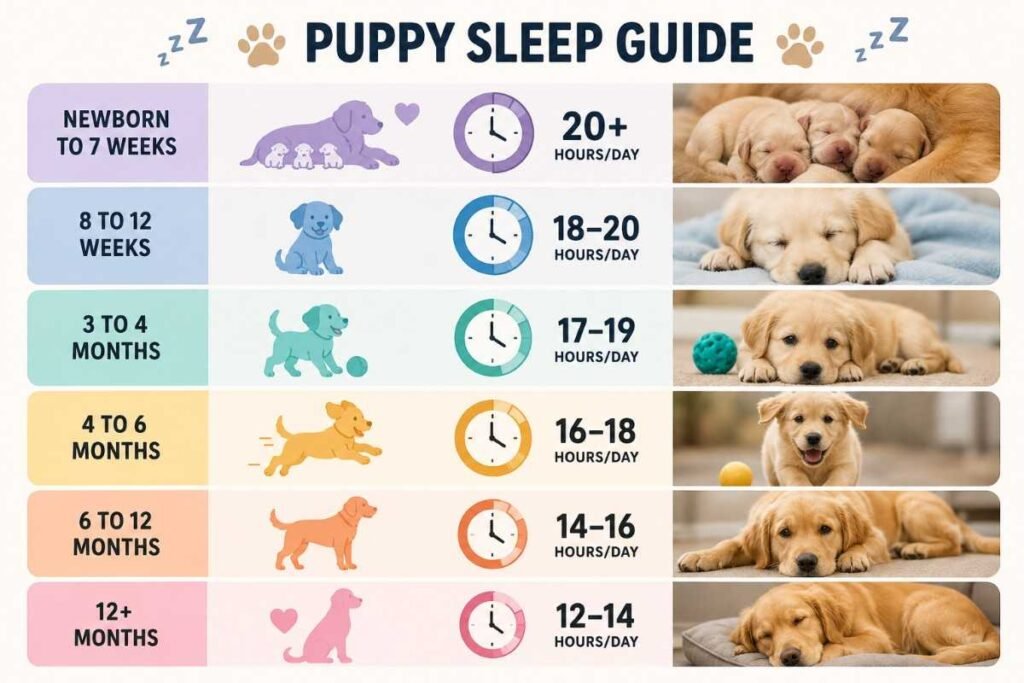
Puppy Sleep Schedule by Age
Every puppy is different, but here’s a general guide to how much sleep they need as they grow.
Newborn to 7 weeks (with mother or breeder)
At this stage, puppies sleep an enormous amount — often 20+ hours a day — waking mainly to nurse. Most owners won’t experience this stage directly since puppies typically go home around 8 weeks.
8 to 12 weeks
This is when most puppies arrive in their new homes, and it’s also peak sleep demand. Expect 18 to 20 hours of sleep per 24-hour period, broken into a nighttime stretch plus frequent daytime naps. Awake windows are short — often just 1 to 2 hours before your puppy needs to wind down again.
3 to 4 months (12–16 weeks)
Sleep needs start easing slightly to around 17 to 19 hours a day. Puppies at this age are more alert and playful during waking hours but still crash hard afterward. Nighttime sleep stretches typically lengthen, and many puppies can start holding their bladder for 5–7 hours overnight.
4 to 6 months
Total sleep drops to roughly 16 to 18 hours daily. This is often when the “second wind” behavior appears — bursts of hyperactive energy in the evening — which is frequently a sign of an overtired puppy fighting sleep rather than one who doesn’t need it.
6 to 12 months
Sleep needs continue tapering toward 14 to 16 hours a day as your puppy edges closer to adult patterns. Nighttime sleep becomes more consolidated, often a full 8-hour stretch without a bathroom break by 5–6 months in most breeds.
12+ months (adolescent to adult)
Most dogs settle into 12 to 14 hours of sleep daily by their first birthday, though large and giant breeds often need more, even into adulthood.
How Breed Affects Puppy Sleep Needs
Some breeds are naturally more active, while others are more relaxed. For example, working breeds like Border Collies and Belgian Malinois may take shorter naps but need more mental stimulation. Giant breeds like Great Danes or Saint Bernards often sleep longer, even into adulthood.
Creating the Perfect Sleep Environment
To help your puppy sleep better, provide a comfortable bed in a quiet space, keep a consistent routine, and avoid loud noises or late-night play sessions. Crate training can also help them feel safe and secure during rest times.
Signs Your Puppy Isn’t Getting Enough Sleep
Watch for signs such as constant barking, nipping, or trouble focusing during training. If your puppy seems unusually tired or restless, consult your veterinarian to rule out any health issues.
How Breed Size Changes the Sleep Equation
Age isn’t the only factor — breed size and energy level matter just as much.
- Toy and small breeds (Chihuahuas, Pomeranians, Yorkies) tend to have faster metabolisms and often nap more frequently in shorter bursts throughout the day, even as adults.
- Working and herding breeds (Border Collies, Australian Shepherds, Belgian Malinois) often need less total sleep than their size would suggest, but require significantly more mental stimulation — under-stimulated working breeds often show sleep disruption as a symptom, not a cause.
- Giant breeds (Great Danes, Saint Bernards, Newfoundlands) frequently sleep longer than other dogs well into adulthood, sometimes 16+ hours daily even at 1–2 years old, because their skeletal growth continues longer.
- Brachycephalic breeds (Bulldogs, Pugs, Boston Terriers) may sleep more due to breathing efficiency differences, and are also more prone to sleep-disrupted breathing, which is worth monitoring.
Building a Sleep Schedule That Actually Works
- Anchor the day with consistent wake and bedtime. Puppies thrive on predictability — even 20-minute swings in routine can affect how easily they settle.
- Time naps around activity, not the clock. Watch for early tiredness cues (slower play, sudden clumsiness, glassy-eyed staring) and start wind-down before a meltdown happens.
- Cut off water and food access before bed. Stopping food roughly 2–3 hours and water about 1 hour before bedtime reduces overnight accidents.
- Use a consistent pre-sleep routine. A short walk, a calm five minutes, then the crate or bed — repeated nightly — teaches the brain that sleep is coming.
- Consider crate training for security, not punishment. A properly sized, covered crate mimics a den environment many puppies find calming.
- Keep the sleep space consistent and quiet. Frequent location changes (couch one night, crate the next) confuse the routine you’re trying to build.
When to Talk to a Vet
Occasional restless nights are normal, especially during teething or after a change in routine. But talk to your veterinarian if you notice persistent difficulty settling, unusual lethargy, sleeping far more or less than breed norms, or labored/noisy breathing during sleep — these can signal underlying health issues rather than a simple scheduling problem.
20 Frequently Asked Questions About Puppy Sleep
1. How many hours a day should an 8-week-old puppy sleep?
Around 18–20 hours total, including nighttime sleep and several daytime naps.
2. Is it normal for my puppy to sleep all day and be awake all night?
Occasionally, yes — puppies haven’t developed a human-aligned circadian rhythm yet. Consistent daytime activity and a firm bedtime routine usually correct this within a couple of weeks.
3. How long can a puppy go without a bathroom break at night?
As a general rule, a puppy can hold it roughly one hour per month of age, up to about 8 hours by 5–6 months.
4. Why does my puppy get hyper right before bedtime?
This is often overtiredness, not extra energy — an overtired puppy frequently becomes more wound up rather than sleepy.
5. Should I wake my puppy up for meals or bathroom breaks?
Generally no for meals once a routine is set, but yes for bathroom breaks during the early crate-training weeks to prevent accidents.
6. Do puppies dream?
Yes — twitching, paddling legs, or small noises during sleep are normal signs of REM sleep and healthy brain activity.
7. How long is a puppy’s sleep cycle?
Roughly 45 minutes per cycle, much shorter than an adult human’s.
8. Is crate training helpful for better sleep?
For most puppies, yes — a properly introduced crate creates a den-like sense of security that supports settling.
9. What’s the best puppy bedtime?
Consistency matters more than the exact hour — most owners find success anchoring bedtime between 8–10 PM with a calm wind-down beforehand.
10. Why won’t my puppy nap during the day?
Overstimulation, an inconsistent environment, or too much daytime noise/activity can all interfere with daytime settling.
11. Do small breed puppies sleep more than large breed puppies?
Not necessarily more overall, but small breeds often nap in shorter, more frequent bursts due to faster metabolisms.
12. At what age do puppies sleep through the night?
Most puppies can sleep a full night without a bathroom break somewhere between 4 and 6 months, though this varies by breed and individual.
13. Can too much sleep be a bad sign in puppies?
Excessive sleep paired with lethargy, appetite loss, or unresponsiveness warrants a vet check — it can occasionally signal illness.
14. Should puppies sleep in bed with owners?
This is a personal choice; some trainers suggest waiting until house-training and crate routines are established first.
15. How much sleep do working breed puppies need?
Similar totals to other breeds, but they typically need more mental engagement during waking hours to avoid restlessness at bedtime.
16. Why does my puppy wake up crying at night?
This is common in the first week or two in a new home and is usually related to separation from littermates rather than a medical issue.
17. Does exercise help puppies sleep better?
Yes, in moderation — appropriate daytime activity supports better nighttime settling, but overexertion can backfire and cause overtired hyperactivity.
18. How do I create a consistent puppy bedtime routine?
Repeat the same short sequence nightly — brief walk, calm-down period, then crate or bed — so the brain associates the pattern with sleep.
19. Do giant breed puppies need more sleep than average?
Often yes, and this can continue well into their second year due to extended skeletal growth.
20. When should I be concerned about my puppy’s sleep habits?
If sleep patterns change suddenly, involve labored breathing, or come with other symptoms like appetite changes or lethargy, consult your veterinarian promptly.
Final Tips for a Healthy Sleep Schedule
There’s no single “correct” puppy sleep schedule — the right one depends on age, breed, and your puppy’s individual temperament. But the pattern is consistent: young puppies need enormous amounts of sleep, that need gradually decreases through the first year, and larger or working breeds often deviate from the average in predictable ways. Build a consistent routine early, and both you and your puppy will sleep a lot better for it. Be patient as your puppy adjusts to their new home and routine. Stick to regular feeding, potty breaks, and playtimes so they naturally fall into a healthy sleep rhythm. With time and consistency, your puppy will learn when it’s time to play—and when it’s time to dream. 🐶💤 PetsDogPuppy